No Background Checks for this Chair by Tony Anegon

I was a tennis player decades before I even considered becoming an official.  In fact, in the 1970s, when I was playing both junior and men’s open events, officials were rarely if ever seen on court.   My first close up experience with a chair umpire in 1975 was in a very unusual place:  Southern Michigan Prison in Jackson, Michigan.  No, I was not there as an inmate.  I was asked to go with a group of 8 players from Saginaw, Michigan to play a team of inmates.  I was 18 and the youngest person in the group by several  years.
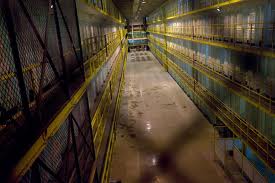
inside Southern Michigan prisonI have many vivid memories about this day at the prison in the summer of 1975.  Southern Michigan Prison, which is now closed, had a huge prison yard inside the walls, approximately 60 acres with ball fields and 2 concrete tennis courts.  Security was much looser than it is today at penal institutions.  When we arrived, we were led to a grubby anteroom and the only thing we were told was that if you brought cigarettes or gum, the packages had to be unopened.  That was it! Our names were checked off on some list, and everyone had an X painted on the back of their hand with some kind of  paint that was only visible under ultraviolet light so we could be distinguished from the inmates when we left.  I worried about the paint coming off the entire time I was inside the walls.  We were led to a door that opened to the prison yard and we were on our own- the yard was full of hundreds of inmates standing and sitting in groups on the ground as it was a very nice summer day.  I stayed very close to my group as we walked to the courts which were a short distance away.  I was nervous to put it mildly.  As we walked across the yard to the courts, inmates were yelling “Buster, hey Buster”.  It wasn’t until we were done that I was told what that was about.  I also remember my sometimes doubles partner Fred Stark and I were both wearing pastel yellow tennis shorts that were popular at the time.  While walking to the courts, an inmate yelled out “I’ll take the one in the yellow shorts” followed by laughter.  Not something I needed to hear right before playing tennis.
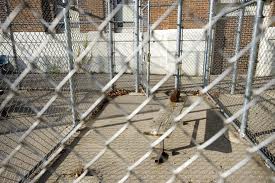
When we arrived at the courts, we were greeted by the prison team who were very friendly and cordial.  They clearly were happy to see people from the outside.  One of the courts had an umpire chair.  There was no prior discussion at least with me as to who was playing who but it was clear that I had been asked to come to play the number one inmate player, the strategy or theory apparently being that I should win, but if I didn’t, well, I was just a kid.  I was introduced to my opponent, the best player in the prison, who immediately informed me that he was doing time for voluntary manslaughter.  This was information I really did not need right before playing, but the inmates would tell you why they were in prison so you did not have to ask.  I don’t remember a coin flip by the chair umpire, who was doing time for second degree murder, but he did say he would be calling all lines.

When the match started, I was as nervous as I can ever remember being on a tennis court.  There were a few non-tennis playing inmates watching, but not many.   Surprisingly, I played very well under the circumstances.  My opponent had good ground strokes but clearly had not played much against my serve and volley, chip and charge style that was suited to the fast hard courts that I played on at the time.  The chair umpire, who actually did a creditable job of keeping and announcing the score, did not call the lines very well.  I was having to return a number of balls that were obviously out and he was calling out balls I hit that were clearly in.  Needless to say, I did not question a call.  I did not say anything or even glance up to the chair when I got a bad call.  I was what all chair umpires want:  players who just play and do not complain.  However, my silence was because of fear and the surroundings.

Despite all of the bad line calls, I won fairly easily, 6-2, 6-1.  As I somewhat nervously shook my opponent’s hand, he was very complimentary and told me he also had gotten a lot of bad calls on his side of the net.  I remember feeling just a little better after he told me that.
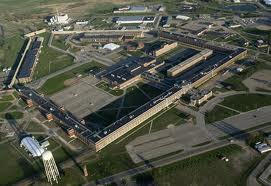
After I played, I stayed very close to the courts watching the others play, afraid to go anywhere although amazingly, we were free to roam the prison yard if we wanted.  The tennis playing psychiatrist in our group did just that and walked all over.  Inmates would come up to us and start conversations, but always friendly and just wanting to talk to people from the outside.  I think I played a set or two of doubles but the details I do not remember.

Our group continued to play until a siren went off and all of the inmates in the yard had to go back to their cells.  We walked towards the same door as the inmates, with the inmates going through the door and to the left with us going to the right.  We all put our hands under an ultraviolet light so the guard could see the X painted on our hands and we were free again.   I can remember a member of a baseball team who was also playing a prison team saying he was glad he didn’t have to live here.  The understatement of the entire day.

When we were leaving the yard, inmates again starting yelling “Buster”.  This time I figured out it was directed at Bob, who was in our group.  After we got out of there, I asked someone what that was about.  It turned out that Bob had organized our prison outing as he had done time there for armed robbery and was on parole. “Buster” was his nickname in prison.  This was news to me and again information I probably didn’t need to know as I hit balls with Bob from time to time.

I don’t know what I learned that summer day in Jackson, Michigan in 1975, but I do know that it is unlikely that I will play tennis in a prison with a convicted felon as a chair umpire again.

Posted in Entertainment | Leave a comment

My Chair Academy Experience at Hilton Head by Julie Dorr

Julie Dorr is the Assignor for NW Washington and loves every aspect of officiating. She certified with the USTA in 2007 and ITA in 2010.

When I was asked to talk about my experience three words came to mind, exciting, intimidating and heart-throbbing!

The exciting part was meeting officials like me, into officiating and loving what we do. We chatted a lot about our experiences working the chair and roving on the court. They had many of the same experiences but heard some new ones, as always learned from them all.

The intimidating portion was when I arrived the first two officials I met worked the lines at Wimbledon and were heading to the US Open to work this summer. I felt maybe I was in over my head, but I did enjoy listening to their experiences, also they did share with me how I can get to New York calling lines myself. That was exciting, another goal put into action. Most all officials at the academy had a lot of college chair experience. My recommendation to whoever is interested in attending the academy is to have a lot experience and feel comfortable in the chair, for you do so much more than just calling the score and marking your score card. We called all lines, needed to call score in by walkie talkies, while having an official escort your player to the restroom and of course checking the net!

The heart-throbbing portion I got over quickly, as I did more matches I felt more comfortable. Never really got over all the observers that we had watching us at each match. Everyone was very helpful though. One of my comments was to “fill the chair” (he said sit like a man). I was told by another official if that’s all they can come up with, I must have had a hell of a match. So I took that as a compliment.

All in all the chair academy was a wonderful experience. I encourage everyone to apply, but go fully prepared for some intense training, a lot of learning and enjoy the great company!

See you on the courts!

Posted in Entertainment, Instructional | Leave a comment

2012 Adidas Open

This slideshow requires JavaScript.

I’ve been working a lot this summer including a couple of days roving the 2012 Adidas Open Championships at Irvington Club in Portland. I had Sunday off, but decided to watch some of the chaired matches and my fellow officials, Darryl Kealy and Steve Halberg, in action. Taking time to watch other officials is a great way to continue learning, especially those like myself who learn more by example than from reading.

Posted in Entertainment, Instructional | Leave a comment

What Are Those “Lunch and Learns?”

lunch and learn

The date is set for the May “Lunch and Learn”, previously referred to as an “Official Gathering“,to be held at West Hills Racquet Club, May 22. This session’s host is Yaeko Jacques, a rookie official who felt that the first session was so fun and informative so she wanted to step up and do her part to make sure we had another one.

Already into my 3rd year of officiating, I definitely don’t feel like I have become the best I can be. While I have experienced enough to effectively do my job, there is a wealth of information in the heads of others and a Lunch and Learn is a prudent place to ask questions and get answers. Yaeko and I expect roughly 15 officials of varying skill and experience to show up with their lunches and in my case, a few questions. Can you make it?


Posted in Entertainment, Events | Leave a comment

The Mental Side of Officiating by Tony Anegon

I was asked to submit a blog which I hope will benefit officials, new and more experienced. The mechanics of officiating take practice and court time to reach a certain level of confidence and competence.  As with the players, the mental side often gets overlooked.  The following are some ideas that will help you with the mental side of officiating.

  1.   Know the rules. Obvious, yes.  But you cannot read the rules too much.  When you go on court you should know the rules better than anyone except maybe other officials.  When a rule question comes up on court, your confidence in providing the answer gives you immediate credibility.  The only way to have that confidence is to read and reread the rules (ITF, the Code, USTA especially relating to code violations and medical timeouts and ITA if you do collegiate).  I read the rules several times a year and learn something new every time I read them.
  2.  Prior to an event, think about the verbiage you will use on court, and anticipate potential problems or issues that may arise during the course of an event. Expect the unexpected.  I also often warm up my voice while driving to an event.  While this may sound silly to some, it helps me focus and the first call of the day comes out a little easier.
  3.   Arrive with the right attitude.  Players want acceptance from their peers, and as officials we want the players to accept us, albeit in a different way.  “Relaxed confidence” is one way to think about your attitude when you arrive at an event. Also, players will have less respect for you if you act unprofessional (talking with spectators, etc.), too casual or nervous.  Just like a judge in a courtroom, you will have fewer problems if it is clear you are in control.
  4.    Play from the first point.  Some players use the first few games of a match as a continuation of the warm up.  As officials, we don’t have that luxury.  Be mentally prepared to make calls from the first point.  An appropriate foot fault or overrule called early in a match often keeps the players on an even keel throughout the entire match.   Ignoring obvious calls because it is early in the match and you aren’t “warmed up” will only cause problems later on.
  5.   Conserve mental energy.  Unnecessary talking or conversation, even if in the context of officiating, drains mental energy that will likely be critical later in the event.  In addition, if you are talking too much on the court to the players, particularly junior or collegiate players, you may be stressing them out as well.
  6.   One point at a time.  This cliché applies to officials as well as players.  If you make what players, coaches, and/or parents perceive as a bad call, remember that like the players, you must move on to the next point.  Do not dwell on the negative as it can only lead to more problems.  Save self-evaluation for after the match.

If you pay attention to the mental side of officiating, you will find that your best officiating experiences will occur when you are focused and confident no matter what happens on court.

Posted in Instructional | Leave a comment

February Gathering

Today, I loved my job. I say loved because I usually just like my job and save love for more important things like my family and chocolate cake. But today was great. I hosted a group of tennis Officials at my house in the first of many, I hope, meetings and social opportunities for us Officials to share our experiences and knowledge with each other.

PNW Tennis Officials

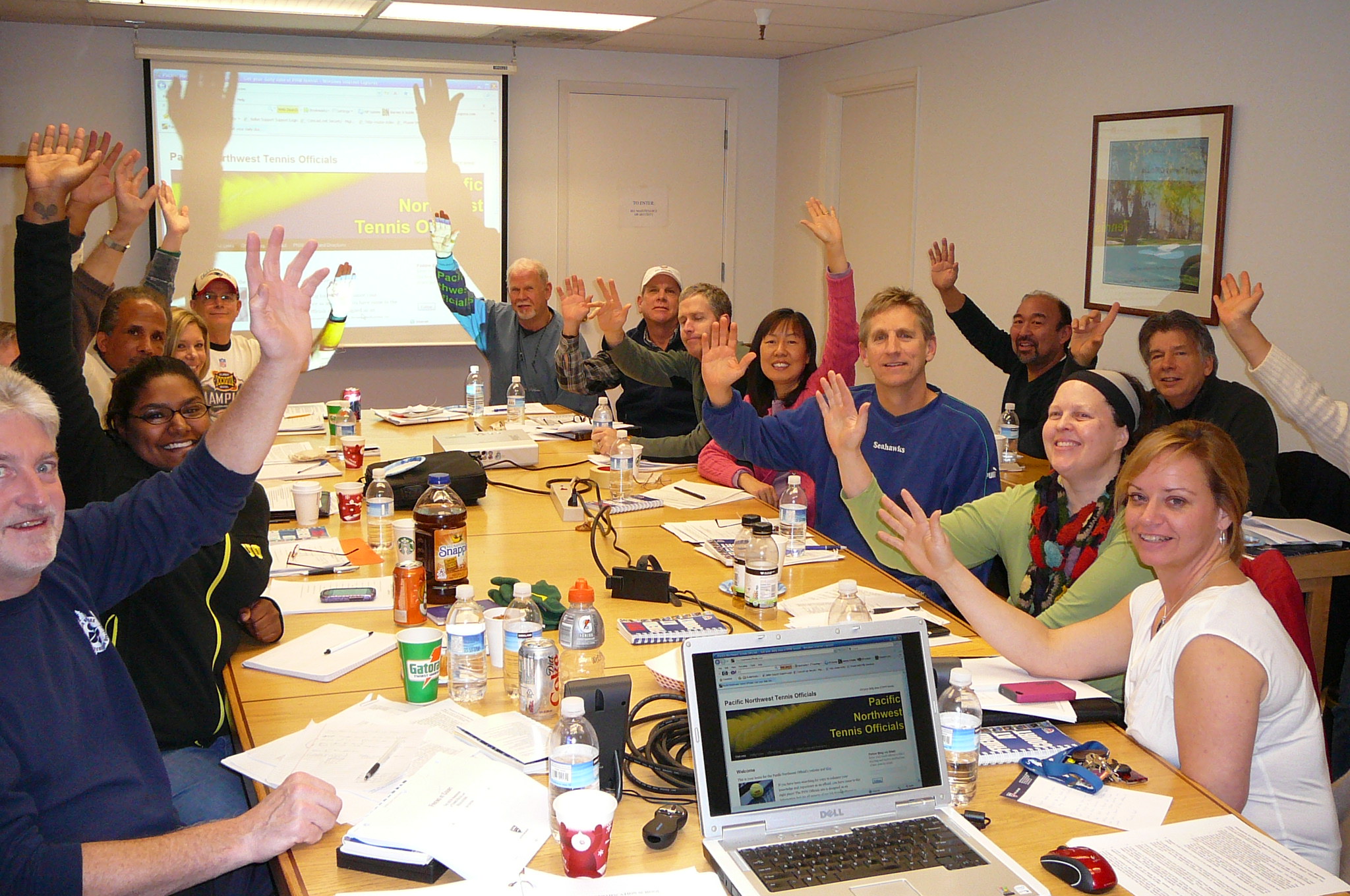
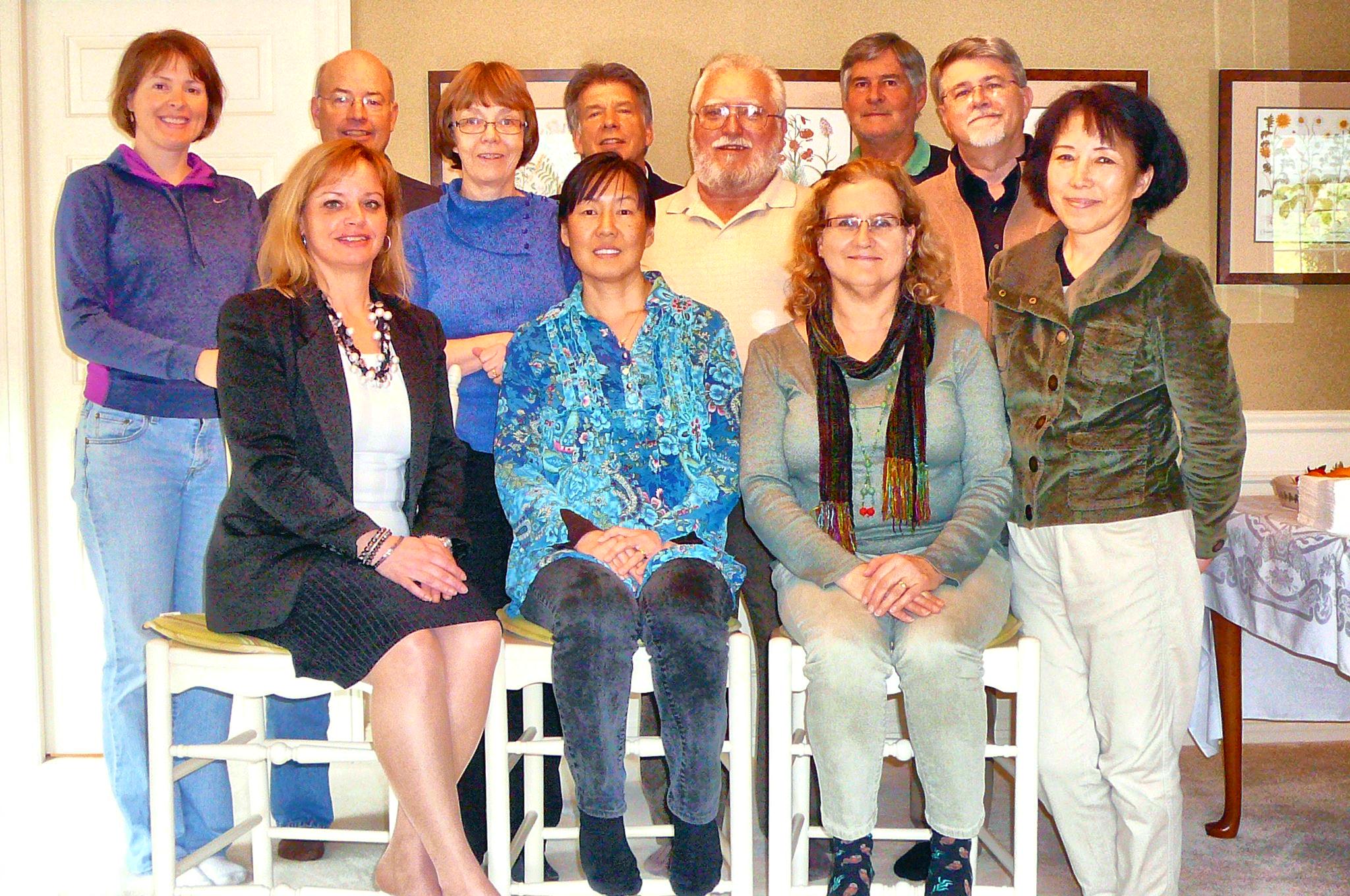
FR: Holly Weyhrauch, Bo Yu, Roberta Kanter, Yaeko Jacques BR: Corinne Mitchell, Russ DeMoss, Debbie Johnson, Mark Benecke, Jeff Carey, Darryl Kealy, Dennis Kviz

I was impressed with the generous nature of the veteran Officials who came to the meeting. I’m sure their patience was tested with us rookies, but Mark Benecke’s comment, “When we’re green, we’re growing.” was well-timed and got a big laugh.

I also learned that there are plans underway for Line Schools and more Chair Schools for our Section. I will post more information as it becomes available. Now …how does April look for the next Official Gathering?

Posted in Entertainment, Events | 2 Comments

Are You Listening??? by Betty Rankin

Your ears play an important role in making you a better official. When roving, you often hear a variety of noises on courts behind you. Even subtle things such as “are you sure” (more than once), excessive racquet hitting the tape/floor/curtain, loud comments of disgust directed at the player him/herself, etc. can mean there are potential problems and you should move to the court in question to observe.(This is particularly helpful if you are covering multiple courts) Obviously, there are the blatant, code-able offences such as obscenity/racket abuse. A new rule for 2011 states that “roving umpires may impose a penalty only if they have seen, heard, or otherwise observed enough to determine with reasonable certainty that a violation has occurred.” (2011 FAC, IV.D.6c) In other words, although you no longer have to be in direct observation, you must be absolutely sure of who/what you’ve heard (you can ask the player) in order to give a code violation. (Interesting that there was a question on the most recent USTA exam concerning this rule.)

Posted in Instructional | 2 Comments

Launch and Learn

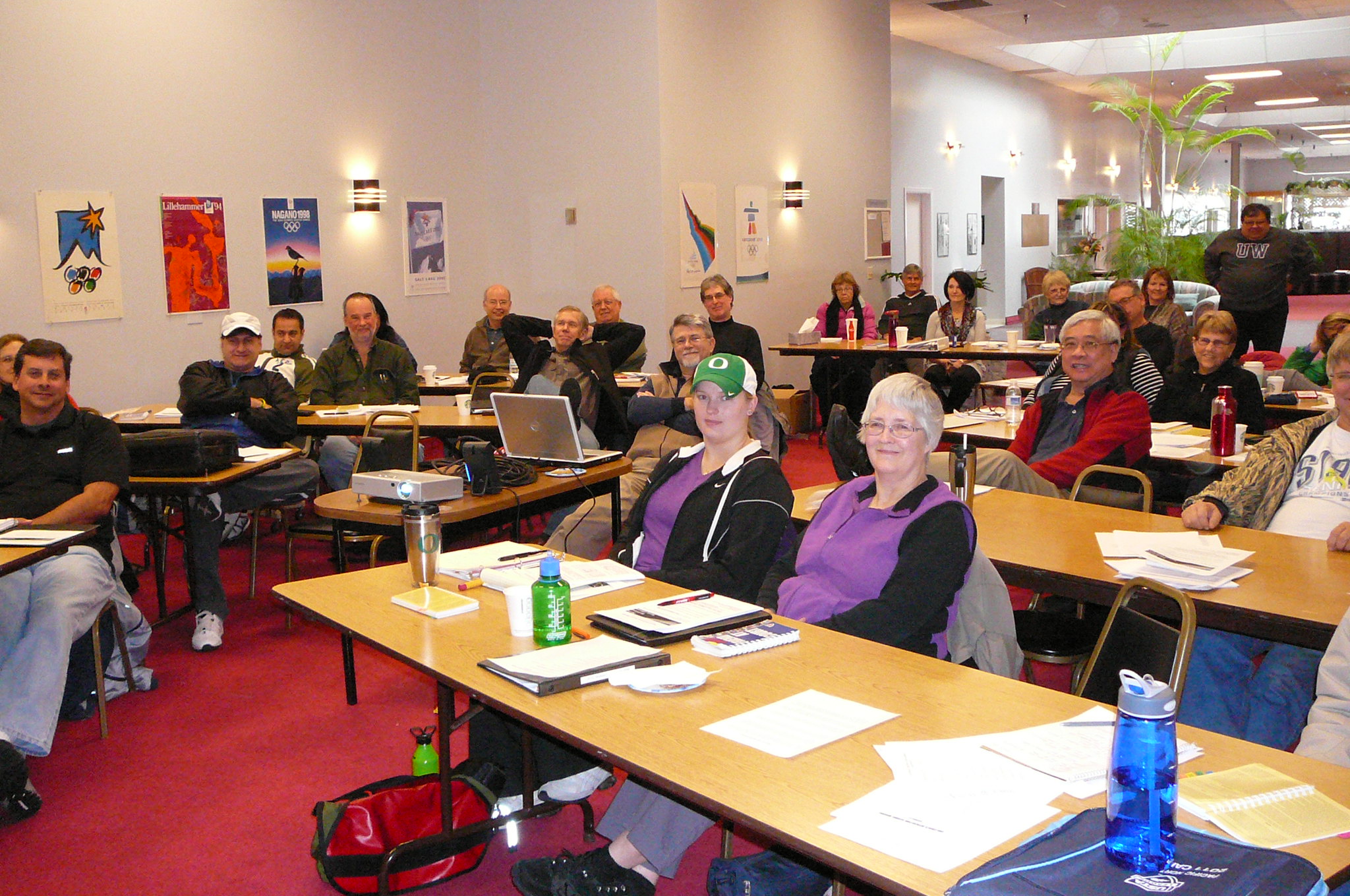
PNW's newest officialsI gave a short presentation about our new website and blog to both USTA certification classes this weekend — you may’ve seen me. This happy group of our Rookie officials and new recruits paid close attention to JaneUSTA Sunday rookie school instructors. Goodman and Steve Halberg — here they are enthusiastically knowing the right answer. Or voting for a break?

PNW's veteran officialsThe next day, I attended the veteran class and tried to count myself as one of them. The collective experience of this group was very intimidating for a rookie like me. As you can tell, they are not easily rattled — taking my short presentation about the new website and blog in stride. Believe me though, they are very excited. Really. No, really!

Anyway, we will test them with our questions and concerns right here in this blog, I’m sure. But first, how was your school experience this year? Any thoughts?

Posted in Events | Tagged | 1 Comment

Sectional School

I didn’t intend to take the month of December off from my blogging duties, it just happened. I didn’t work much either, but the craziness of December shopping, parties, and holidays (and two family birthdays) always leave me feeling like I need a vacation but instead it’s back to work — and school.

If you are planning to attend Sectional school next weekend you are plowing through the tests just like me; I took the USTA test in late December, the ITA test is next on my list. I’m not going to take the Referee test or class yet, I still have a lot to learn and master before taking that on. I’ve heard that there will be a Chair School offered sometime in January, but haven’t heard anything more about it.

USTA Sectional School will be held here in Beaverton, Oregon on January 14th and 15th, however, the Veteran class will be Sunday and the Rookie class will be Saturday. I will be taking the Veteran class for the 1st time, although I may drop in on the Rookie class on Saturday to say hello and invite them to our blog because the more, the merrier. Merry Officiating!

Posted in Events | 1 Comment

Involuntary Hindrance — You Make the Call

I’m watching the Barclays World Tour Finals as much as I can and I saw something interesting during the Llodra-Zimonjic/Bopanna-Qureshi doubles match. Bopanna hit a lob that went up through the overhead scoreboard (think Jumbo-tron). Zimonjic thought they won the point and yelled, but the ball fell inside the lines. Bopanna and Qureshi stopped playing after hearing Zimonjic yell and were upset with the chair official for deciding to replay the point based on an “involuntary hindrance.”

After watching the video, please comment on whether or not you agree with the call.

Posted in Instructional | 2 Comments